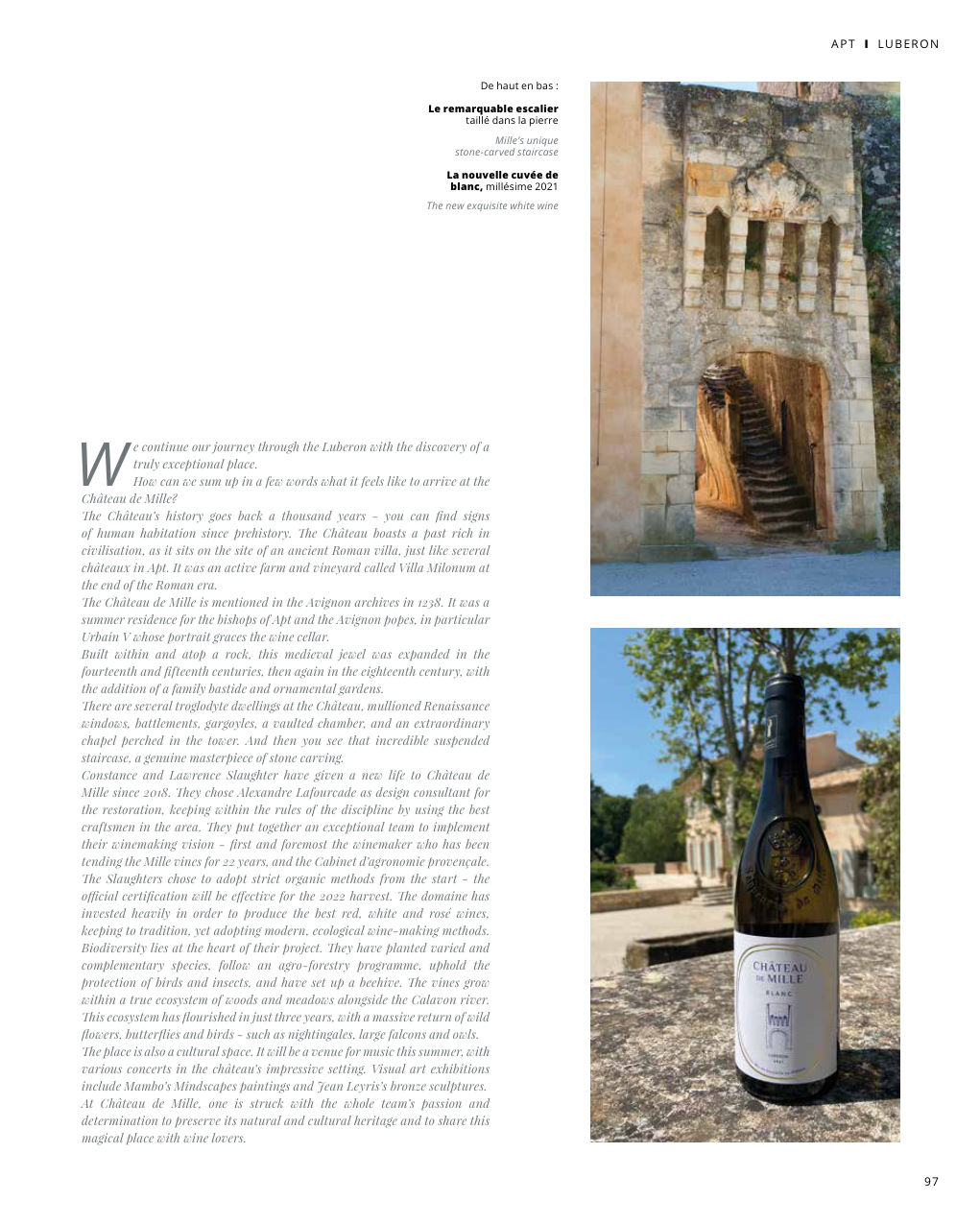
De haut en bas :
Le remarquable escalier
taillé dans la pierre
Mille’s unique
stone-carved staircase
La nouvelle cuvée de
blanc, millésime 2021
The new exquisite white wine
W
e continue our journey through the Luberon with the discovery of a
truly exceptional place.
How can we sum up in a few words what it feels like to arrive at the
Château de Mille?
The Château’s history goes back a thousand years - you can find signs
of human habitation since prehistory. The Château boasts a past rich in
civilisation, as it sits on the site of an ancient Roman villa, just like several
châteaux in Apt. It was an active farm and vineyard called Villa Milonum at
the end of the Roman era.
The Château de Mille is mentioned in the Avignon archives in 1238. It was a
summer residence for the bishops of Apt and the Avignon popes, in particular
Urbain V whose portrait graces the wine cellar.
Built within and atop a rock, this medieval jewel was expanded in the
fourteenth and fifteenth centuries, then again in the eighteenth century, with
the addition of a family bastide and ornamental gardens.
There are several troglodyte dwellings at the Château, mullioned Renaissance
windows, battlements, gargoyles, a vaulted chamber, and an extraordinary
chapel perched in the tower. And then you see that incredible suspended
staircase, a genuine masterpiece of stone carving.
Constance and Lawrence Slaughter have given a new life to Château de
Mille since 2018. They chose Alexandre Lafourcade as design consultant for
the restoration, keeping within the rules of the discipline by using the best
craftsmen in the area. They put together an exceptional team to implement
their winemaking vision - first and foremost the winemaker who has been
tending the Mille vines for 22 years, and the Cabinet d’agronomie provençale.
The Slaughters chose to adopt strict organic methods from the start - the
official certification will be effective for the 2022 harvest. The domaine has
invested heavily in order to produce the best red, white and rosé wines,
keeping to tradition, yet adopting modern, ecological wine-making methods.
Biodiversity lies at the heart of their project. They have planted varied and
complementary species, follow an agro-forestry programme, uphold the
protection of birds and insects, and have set up a beehive. The vines grow
within a true ecosystem of woods and meadows alongside the Calavon river.
This ecosystem has flourished in just three years, with a massive return of wild
flowers, butterflies and birds - such as nightingales, large falcons and owls.
The place is also a cultural space. It will be a venue for music this summer, with
various concerts in the château’s impressive setting. Visual art exhibitions
include Mambo’s Mindscapes paintings and Jean Leyris’s bronze sculptures.
At Château de Mille, one is struck with the whole team’s passion and
determination to preserve its natural and cultural heritage and to share this
magical place with wine lovers.
APT I LUBERON